


Hearing aid or sound amplifier
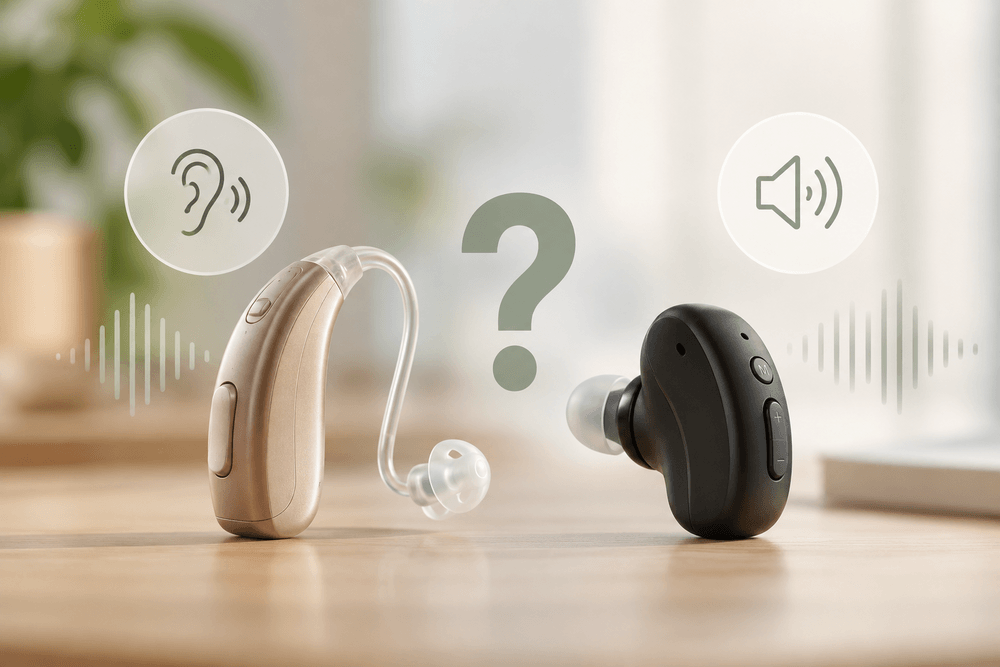
At first glance, these devices may look quite similar: a compact body, a microphone, a speaker, and volume controls. This naturally raises a question — why buy and professionally fit a hearing aid if a simpler sound amplifier is available?
The difference becomes clear when you look beyond the casing and consider how each device works. A sound amplifier makes surrounding sounds louder. A hearing aid is designed to compensate for the specific parts of a person’s hearing that are reduced. In everyday communication, these are fundamentally different tasks.
How does a sound amplifier work?
A sound amplifier picks up the surrounding sound and increases its volume. Along with the voice of the person you are speaking to, it may also make the hum of a fan, traffic, clattering dishes, music, and other background sounds more noticeable.
For someone without significant hearing loss, such a device may occasionally be useful in situations where a quiet sound needs to be heard more clearly. However, it does not know which frequencies a particular person hears poorly and cannot take an individual pattern of hearing loss into account.
Imagine a photograph where small details are hard to see. If you simply increase the brightness of the entire image, it becomes lighter, but the details do not necessarily become clearer. A basic sound amplifier works in much the same way.
How is a hearing aid different?
Hearing loss rarely means that all sounds simply become equally quieter. A person may hear low frequencies relatively well but have more difficulty with higher ones. This is why a voice may be audible while individual words still seem unclear.
A hearing aid is fitted with these differences in mind. After a hearing assessment, a specialist can see which frequencies need more correction and which are already heard well enough.
Modern hearing aids can process sound across several frequency ranges, work with speech and background noise, limit excessively loud sounds, and use different listening programs for different situations.
The goal is not to make the entire world as loud as possible, but to make sound clearer and more comfortable.
Why louder does not always mean clearer
This becomes especially noticeable during conversation.
A person with hearing loss may ask others to speak louder, but even a louder voice does not always become easier to understand. Some speech sounds are heard normally, while others are missed. As a result, the sentence is audible, but individual words still have to be guessed from context.
If the entire signal is amplified, background noise becomes louder as well. In a café, for example, a person may hear dishes and nearby conversations more strongly, while the voice of the person sitting across the table can still get lost in the noise.
This is why hearing correction is not only about volume. The specific pattern of hearing loss matters just as much.
Key differences
In simple terms, the difference can be summarised like this:
Sound amplifier:
- increases the volume of incoming sound;
- usually offers limited options for individual adjustment;
- is not programmed based on the user’s audiogram;
- amplifies background noise together with speech;
- does not replace professional hearing correction for diagnosed hearing loss.
Hearing aid:
- is selected based on hearing test results;
- is adjusted to the individual characteristics of a person’s hearing;
- can correct different frequency ranges in different ways;
- may use algorithms for speech processing and background noise reduction;
- can be readjusted by a specialist when necessary.
At the same time, the capabilities of specific models vary. Even a good hearing aid should not be judged only by the number of features it has. Proper selection and fitting are just as important.
Why price should not be the only factor
The price difference can be significant. That is why an inexpensive sound amplifier may seem like an easy way to “try it first” and see whether hearing improves.
The problem is that this kind of experiment says very little about the actual condition of a person’s hearing. If speech remains unclear, the person may conclude that no device will help. If sounds become louder, the opposite mistake can happen — assuming that the hearing problem has been fully solved.
In reality, the first step is to understand why hearing has become more difficult. The cause may not be limited to age-related changes in hearing sensitivity. In some cases, an examination by a doctor may be needed.
That is why the starting point should be a hearing assessment rather than the purchase of a device.
Can a sound amplifier replace a hearing aid?
If hearing loss has been confirmed and hearing rehabilitation is recommended, a basic amplifier is not an equivalent replacement for a professionally fitted hearing aid.
This difference becomes especially noticeable in complex listening situations: outdoors, in a group, on the phone, or during a conversation with the television playing in the background. In these situations, the device needs to work with the user’s specific hearing profile, not simply add more volume.
An incorrectly chosen level of amplification can also cause significant discomfort. If a person constantly has to adjust the volume, remove the device because sounds feel too sharp, or strain to understand speech, it is difficult to consider that effective hearing correction.
Where to start if your hearing has changed
There is no need to choose a particular device straight away. It is more useful to first understand what is happening with your hearing.
Pay attention if you:
- ask people to repeat themselves more often;
- increase the television volume;
- find conversations in groups harder to follow;
- sometimes miss the phone or doorbell;
- notice that speech sounds loud enough but remains unclear.
In these situations, it is better to have your hearing tested and speak with a specialist. After the assessment, it will be clearer whether hearing correction is needed and which option is suitable.
Choose comfort, not just volume
The main difference between a sound amplifier and a hearing aid is not found in the specifications on the packaging. It becomes obvious in everyday life.
A person does not simply want to hear more noise. They want to talk comfortably with family, understand a doctor’s question, follow a conversation in a shop, and feel more confident around other people.
That is why hearing problems should be approached with diagnosis first, rather than by simply making the surrounding world louder. Good hearing correction should restore not just volume, but clarity and comfort — the things that truly make everyday communication easier.